In rubber and tyre manufacturing, surface finishing is often the final step that defines product quality and visual consistency. Whether it involves protective coatings, branding layers, or finishing treatments, the outcome depends heavily on the environment in which coating is performed.
Unlike controlled industries, rubber and tyre plants operate in conditions with high heat, airborne particles, oil vapors, and process emissions. These factors create a challenging environment for painting operations, making standard paint booth setups insufficient.
Without proper ventilation and airflow control, these contaminants interfere with coating processes, leading to inconsistent finishes and operational inefficiencies. This makes paint booth ventilation a critical factor in ensuring quality and reliability.
The Real Impact of Poor Ventilation
In rubber and tyre plants, inadequate paint booth ventilation leads to multiple quality and operational challenges.
Airborne rubber dust, oil mist, and fumes can settle on coated surfaces, causing defects such as uneven texture, poor adhesion, and inconsistent finish. High temperatures further worsen the issue by affecting paint drying behavior.
Additionally, poor airflow leads to overspray accumulation inside the booth, reducing visibility and affecting operator precision. Over time, this results in higher rework, increased paint consumption, and reduced productivity.
- Surface defects and inconsistent coating quality
- Contamination from dust and oil vapors
- Increased overspray and paint wastage
- Reduced operator visibility and efficiency
- Higher rework and maintenance costs
These issues directly impact both product quality and operational performance.
Why Standard Paint Booths Fail in Rubber & Tyre Plants
Conventional paint booths are not designed to handle the unique challenges of rubber and tyre manufacturing environments.
Most systems focus on basic airflow without considering high dust loads, heat levels, and process emissions. As a result, airflow becomes unstable, and contaminants are not effectively controlled.
- Inadequate airflow for high dust environments
- Poor filtration for fine rubber particles
- Lack of temperature and airflow balance
- Inefficient extraction of fumes and vapors
This leads to inconsistent coating conditions and reduced system performance.
How Engineered Ventilation Systems Improve Performance
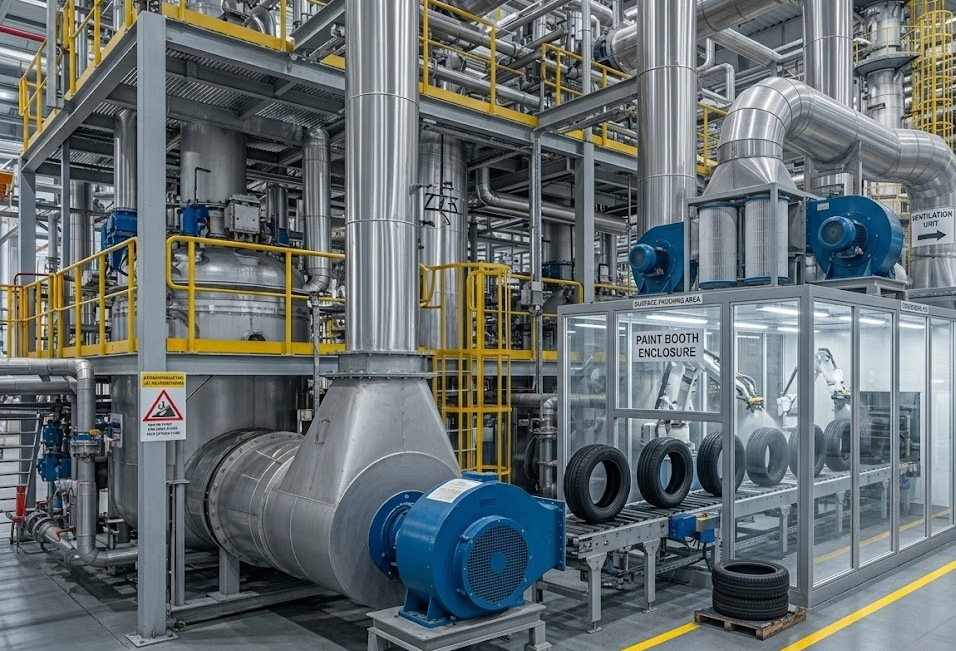
Effective paint booth ventilation in rubber and tyre plants requires a combination of controlled airflow, efficient extraction, and robust filtration.
Airflow systems are designed to maintain uniform air movement across the booth, preventing turbulence and ensuring consistent coating application. High-efficiency filtration systems capture rubber dust and fine particles before they reach the coating area.
Extraction systems remove overspray, fumes, and oil vapors, maintaining a clean and safe working environment. Industrial blowers ensure consistent airflow velocity, even under high-load conditions.
- Uniform airflow distribution for consistent coating
- High-efficiency filtration for dust and particles
- Effective extraction of fumes and oil vapors
- Optimized blower systems for stable performance
This integrated approach ensures reliable and high-quality finishing results.
What This Means for Your Business
Proper paint booth ventilation delivers significant benefits in rubber and tyre manufacturing operations.
- Improved finish quality and consistency
- Reduced rework and paint wastage
- Enhanced operator safety and working conditions
- Lower maintenance and operational costs
- Increased production efficiency
It ensures that coating processes remain stable even in challenging environments.
Edynamics Approach
Edynamics designs paint booth ventilation systems specifically for demanding industrial environments like rubber and tyre plants.
Each solution is customized based on process conditions, emission levels, and environmental challenges. Airflow, extraction, and filtration systems are integrated to deliver consistent performance.
- Application-specific ventilation design
- High-performance filtration systems
- Integrated airflow and extraction solutions
- Focus on durability and efficiency
This ensures long-term reliability and consistent coating quality.
Don’t Ignore Ventilation Challenges
Ventilation issues often go unnoticed until quality problems increase.
- Visible dust contamination on coated surfaces
- Uneven or inconsistent finishes
- High paint consumption and overspray
- Frequent maintenance and filter replacement
Ignoring these signs can lead to significant operational losses.
Evaluate Your Current Ventilation System
Rubber and tyre manufacturing environments present unique challenges that demand specialized solutions.
Paint booth ventilation is not just about air movement—it is about controlling contaminants, ensuring consistency, and maintaining performance under demanding conditions.
In modern industrial operations, achieving consistent surface finishing requires more than equipment—it requires engineered airflow solutions designed for your environment.