Walk into many manufacturing facilities during the summer months and you’ll immediately notice the challenge: excessive heat.
Workers perspire heavily, machines radiate warmth, air feels stagnant, and productivity gradually declines throughout the day. While heat is often accepted as an unavoidable part of industrial operations, the reality is different. Excessive temperatures can significantly impact worker safety, operational efficiency, equipment performance, and product quality.
From fabrication shops and automotive component manufacturing units to foundries, engineering workshops, food processing facilities, and warehouses, industrial heat management has become a critical operational priority.
The good news? Properly designed ventilation systems can dramatically improve workplace conditions without relying solely on expensive air conditioning systems.
Why Do Manufacturing Facilities Become Excessively Hot?
Industrial buildings generate heat from multiple sources simultaneously.
1. Process Heat
Manufacturing operations often involve:
- Welding
- Cutting
- Grinding
- Forging
- Heat treatment
- Painting and curing
- Injection molding
- Drying operations
Each process releases heat into the workspace.
2. Machinery Heat
Equipment such as:
- Compressors
- Hydraulic power packs
- CNC machines
- Furnaces
- Boilers
- Motors
- Transformers
continuously release heat throughout production hours.
3. Solar Heat Gain
Metal roofing and wall cladding absorb solar radiation during the day.
Without proper ventilation, this heat accumulates beneath the roof and gradually spreads throughout the facility.
4. Occupancy Heat
A large workforce itself contributes additional heat, especially in enclosed production areas.
The Hidden Costs of Excessive Factory Heat
Many organizations underestimate how much heat affects their business.
Reduced Worker Productivity
Research consistently shows productivity decreases as workplace temperatures rise beyond comfort levels.
Workers experience:
- Fatigue
- Reduced concentration
- Slower response times
- Lower output rates
Tasks requiring precision become more difficult.
Increased Safety Risks
Heat stress can lead to:
- Dizziness
- Dehydration
- Muscle cramps
- Heat exhaustion
- Reduced alertness
This increases the likelihood of workplace incidents and accidents.
Product Quality Issues
High temperatures can affect:
- Paint curing consistency
- Material handling
- Dimensional tolerances
- Packaging quality
- Storage conditions
Poor environmental control often translates into quality-related losses.
Equipment Performance Problems
Overheated environments can accelerate:
- Motor failures
- Electrical faults
- Bearing wear
- Compressor inefficiencies
Maintenance costs increase while equipment reliability decreases.
Signs Your Factory Has a Heat Problem
Many facilities adapt to heat rather than solve it.
Common warning signs include:
✓ Employees frequently requesting additional fans
✓ Workers gathering near entrances for fresh air
✓ Condensation or excessive sweating around machinery
✓ Uneven temperatures across the facility
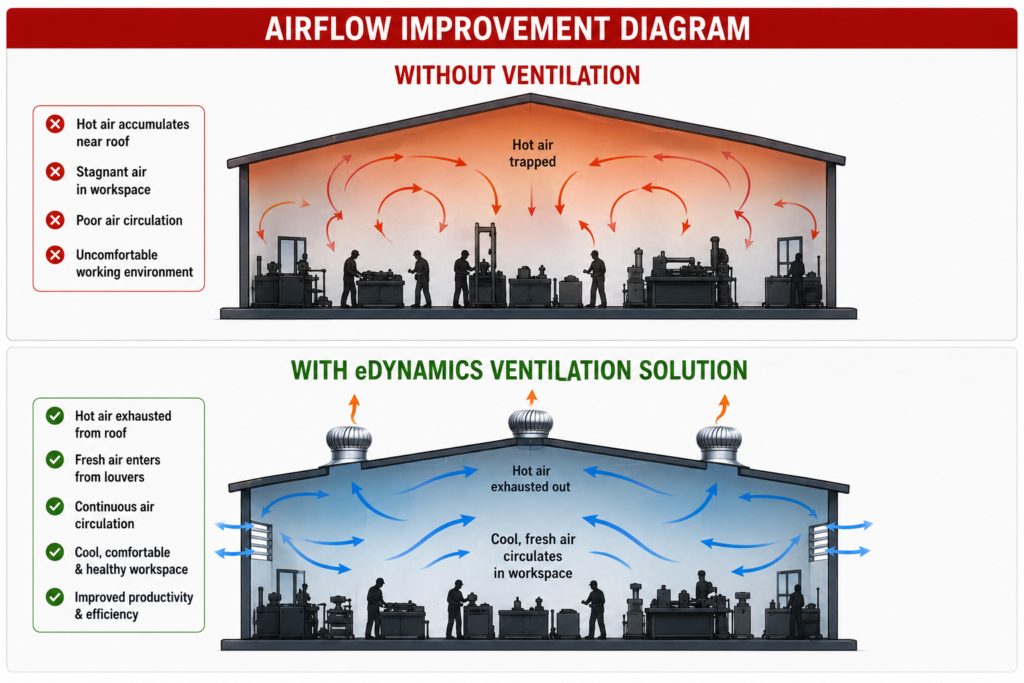
✓ Hot air trapped near the roof
✓ Complaints during afternoon shifts
✓ Rising absenteeism during summer months
✓ Increased energy consumption
If several of these symptoms are present, the facility likely requires a ventilation assessment.
Why Exhaust Fans Alone Often Fail
A common misconception is that installing more exhaust fans will solve heat issues.
Unfortunately, ventilation is not simply about removing air.
For every cubic meter of air exhausted, an equivalent volume of fresh air must enter the building.
Without adequate fresh air intake:
- Negative pressure develops
- Airflow becomes restricted
- Hot zones remain
- Fan efficiency drops
The result is disappointing performance despite increased equipment costs.
The Science of Effective Heat Removal
Successful industrial ventilation follows a simple principle:
Remove Hot Air + Introduce Fresh Air = Thermal Comfort
An effective system includes:
Heat Extraction
Removing accumulated hot air from:
- Roof spaces
- Process areas
- Machine zones
Fresh Air Supply
Introducing cooler outside air through:
- Louvers
- Fresh air fans
- Air inlets
Air Circulation
Ensuring airflow reaches occupied workspaces.
Heat Source Control
Capturing heat close to where it is generated whenever possible.
How eDynamics Tackles Industrial Heat Challenges
At eDynamics, every facility is treated as a unique engineering challenge.
Rather than offering standard products, the team focuses on understanding airflow behavior and process requirements.
Step 1: Site Heat Assessment
The process begins with:
- Heat load evaluation
- Temperature measurements
- Airflow analysis
- Process review
- Building assessment
The objective is to identify where heat is generated and how it moves throughout the facility.
Step 2: Ventilation Design
Based on assessment findings, customized solutions may include:
Roof Exhaust Systems
Removing accumulated heat from the highest points within the building.
Fresh Air Ventilation Systems
Ensuring balanced airflow and proper air replacement.
Industrial Exhaust Fans
Strategically positioned to maximize airflow efficiency.
Air Circulation Solutions
Eliminating stagnant zones and improving worker comfort.
Step 3: Installation and Optimization
Proper implementation ensures:
- Balanced airflow
- Reduced heat pockets
- Improved temperature distribution
- Long-term performance
Post-installation verification confirms system effectiveness.
Case Study 1: Engineering Fabrication Facility
Challenge
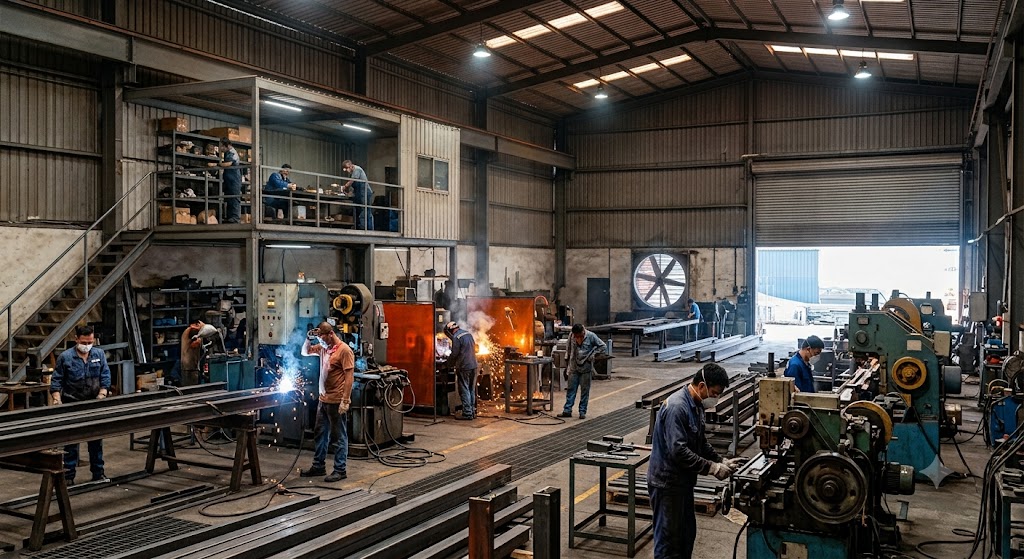
A metal fabrication facility experienced:
- Excessive heat from welding stations
- Poor air movement
- Worker discomfort during afternoon shifts
Temperatures near production areas consistently exceeded acceptable comfort levels.
Key Problems
- Roof heat accumulation
- Inadequate fresh air supply
- Localized heat pockets
eDynamics Solution
The facility was upgraded with:
- Roof-mounted exhaust systems
- Fresh air intake provisions
- Optimized airflow pathways
Results
✔ Noticeable reduction in shop-floor temperatures
✔ Improved worker comfort
✔ Better air movement across production areas
✔ Reduced employee complaints
✔ Enhanced productivity during peak summer months
Case Study 2: Automotive Component Manufacturing Unit
Challenge
An automotive supplier faced:
- Heat build-up from CNC machinery
- Compressor room heat migration
- Uneven temperature distribution
Workers reported significant discomfort during long shifts.
eDynamics Solution
A comprehensive ventilation redesign included:
- High-capacity roof exhaust ventilation
- Dedicated fresh air introduction
- Improved airflow balancing
Results
✔ More uniform temperatures throughout the facility
✔ Improved employee satisfaction
✔ Better machine operating conditions
✔ Reduced dependence on pedestal fans
Case Study 3: Industrial Warehouse and Storage Facility
Challenge
Warehouse personnel reported:
- Extremely hot conditions beneath metal roofing
- Poor air circulation
- Heat retention after sunset
eDynamics Solution
Implementation included:
- Roof ventilators
- Natural ventilation enhancement
- Strategic air movement systems
Results
✔ Reduced heat accumulation
✔ Improved storage environment
✔ Better worker comfort
✔ Enhanced operational efficiency
Measuring the Return on Ventilation Investment
Many facility managers focus solely on equipment costs.
However, the real ROI comes from:
Productivity Gains
Comfortable employees perform better.
Reduced Absenteeism
Lower heat stress leads to improved attendance.
Improved Equipment Reliability
Cooler environments reduce maintenance issues.
Better Product Quality
Stable conditions support consistent production.
Energy Savings
Proper ventilation often reduces reliance on supplementary cooling equipment.
Factory Reality Check
Ask yourself:
- Do employees complain about heat every summer?
- Are multiple pedestal fans used throughout the facility?
- Is the roof area significantly hotter than ground level?
- Does productivity decline during afternoon shifts?
- Are certain zones noticeably hotter than others?
If the answer is yes to several of these questions, your facility may be losing efficiency due to excessive heat.
Let eDynamics assess your facility and design a ventilation solution tailored to your process and workplace needs.
Heat is more than a comfort issue—it directly affects safety, productivity, equipment performance, and operational costs.
A well-designed industrial ventilation system doesn’t simply move air; it creates a healthier, more efficient workplace where people and processes perform at their best.
At eDynamics, we help industries identify the root causes of excessive heat and develop customized ventilation solutions that deliver measurable improvements in workplace conditions and operational efficiency.